
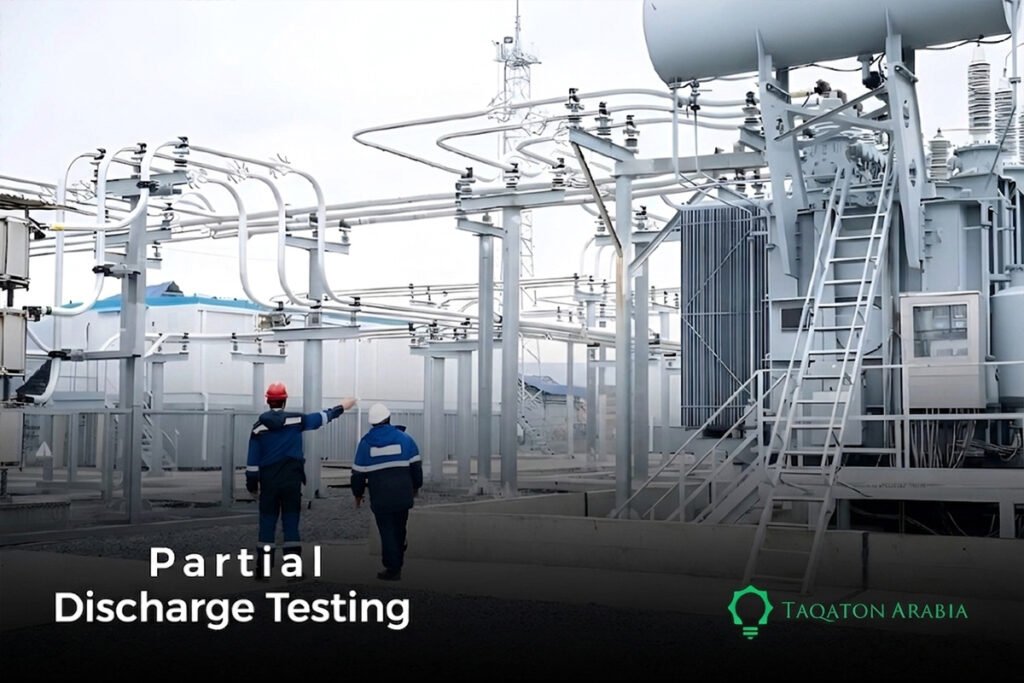
What is Partial Discharge Testing ?
At Taqat Arabia, the Partial Discharge (PD) Test is considered one of the most important electrical tests performed on high-voltage equipment such as transformers, cables, and generators. This test aims to detect partial discharge and identify early insulation defects or deterioration before they escalate into major failures or power outages. By monitoring partial discharge activity, equipment safety can be ensured, failure risks reduced, and the operational lifespan of electrical components significantly extended. What is Partial Discharge? Partial Discharge (PD) is a localized electrical discharge that occurs within or on the surface of electrical insulation without causing a complete breakdown between conductors. It usually takes place in high-voltage equipment such as transformers, cables, generators, and switchgear. Although partial discharge is small and often invisible or inaudible, it is a clear indicator of insulation defects such as air voids, moisture, contamination, or aging insulation. Over time, repeated partial discharges can degrade the insulation, reduce equipment lifespan, and eventually lead to serious failures if not detected and managed early. That is why monitoring and testing for partial discharge is essential to ensure safe, reliable, and long-term operation of electrical systems. Why does Partial Discharge Testing Matter? Partial Discharge (PD) Testing matters because it helps detect insulation problems early—before they turn into serious failures. Partial discharge is often invisible and does not cause immediate breakdown, but over time it can severely damage electrical insulation. PD testing allows engineers to identify hidden defects and take preventive action, ensuring reliable and safe operation of electrical systems. Order the service now from Taqat Arabia website Why PD Testing Is Important: Early fault detection: Identifies insulation defects such as voids, moisture, and cracks at an early stage. Prevention of unexpected failures: Reduces the risk of sudden equipment breakdowns and power outages. Extended equipment lifespan: Helps protect transformers, cables, and generators from long-term insulation damage. Improved electrical safety: Minimizes fire risks and protects both equipment and personnel. Cost savings: Prevents expensive repairs, unplanned downtime, and asset replacement. In short, Partial Discharge Testing is a critical preventive maintenance tool that ensures electrical systems operate safely, efficiently, and reliably over the long term. Where can Partial Discharge Occur? Partial Discharge (PD) can occur in several locations within electrical systems, mainly where insulation is stressed or defective. It typically appears in high-voltage equipment and components. Where Partial Discharge Can Occur: Inside insulation materials: Due to internal voids, air gaps, or manufacturing defects within solid or liquid insulation. On insulation surfaces: Caused by moisture, dirt, pollution, or contamination on the surface of insulating materials. At sharp edges and high-field areas: Such as conductor tips, joints, or irregular shapes, leading to corona discharge. At cable joints and terminations: Where improper installation or aging insulation creates weak points. Within transformers and switchgear: Especially in windings, bushings, and internal insulation systems. In gas-insulated systems (GIS): Due to particles, defects, or insulation deterioration inside the enclosure. Identifying where partial discharge occurs is essential for accurate fault diagnosis, effective maintenance, and preventing major electrical failures. Also Read: What is Preventive Maintenance? Order the service now from Taqat Arabia website What are the Types of Partial Discharge? Partial Discharge (PD) occurs in several forms, depending on where and how it develops within electrical insulation systems. The main types include: Types of Partial Discharge: Internal Partial Discharge Occurs within the insulation material due to internal voids, air pockets, or manufacturing defects. It is one of the most critical types because it causes gradual internal insulation deterioration. Surface Partial Discharge Takes place along the surface of insulation, often caused by moisture, contamination, or pollution. If not controlled, it can lead to surface erosion and insulation failure. Corona Discharge Appears around sharp edges, points, or conductors where the electric field is highly concentrated. It may produce a faint glow or humming sound and can damage nearby insulation over time. Tracking (Creeping) Discharge Occurs along contaminated or moist insulation surfaces between two conductive parts, creating conductive paths that progressively degrade the insulation. Understanding these types helps engineers identify the source of insulation problems, choose the correct maintenance strategy, and prevent major electrical failures. Also Read: What is predictive maintenance (PdM) ? What online partial discharge testing techniques are available? Online partial discharge (PD) testing techniques are methods used to detect and monitor partial discharge activity while electrical equipment is in normal operation, without shutting it down. The most common online PD testing techniques include: Online Partial Discharge Testing Techniques: Electrical (HF/VHF/UHF) Measurement Detects high-frequency electrical signals generated by partial discharge using coupling capacitors, HFCTs (High-Frequency Current Transformers), or UHF sensors. Commonly used for cables, transformers, and GIS. Ultrasonic / Acoustic Emission Testing Uses acoustic sensors to detect ultrasonic sound waves produced by partial discharge, especially effective for transformers, switchgear, and rotating machines. UHF PD Detection (for GIS) Employs ultra-high-frequency sensors installed inside or outside Gas Insulated Switchgear (GIS) to detect PD activity caused by internal defects or particles. Transient Earth Voltage (TEV) Measurement Measures transient voltages on the metal surfaces of switchgear caused by internal PD activity. Widely used for medium-voltage switchgear. Optical PD Detection Uses UV or corona cameras to visually detect corona and surface discharges on exposed high-voltage equipment. Online Cable PD Monitoring (HFCT-based) Continuous monitoring of PD signals on power cables and joints using HFCT sensors for early fault detection. Order the service now from Taqat Arabia website How to Test for Partial Discharge? 1- Online Partial Discharge Testing (Equipment remains in normal operation) HFCT (High-Frequency Current Transformer) Installed around grounding conductors or cable screens to detect PD current pulses. UHF Sensors Used mainly in GIS and transformers to capture high-frequency electromagnetic signals. TEV (Transient Earth Voltage) Measurement Applied to metal-clad switchgear to detect surface voltages caused by internal PD. Ultrasonic / Acoustic Sensors Detect ultrasonic sound waves generated by PD, suitable for transformers and switchgear. Optical / UV Cameras Used to visually identify corona and surface discharges on exposed equipment. 2- Offline Partial Discharge Testing (Equipment is taken out of service) AC PD Testing PD is measured under