
Condition-Based Maintenance is a maintenance strategy that uses the actual condition of equipment to determine when inspection or maintenance is required, rather than relying only on fixed schedules or waiting for failure. Taqaton Arabia provides condition monitoring and engineering inspection solutions that help facilities detect abnormal equipment conditions and support data-driven maintenance decisions.
This approach is particularly valuable for facilities that depend on critical electrical and mechanical assets. Equipment Condition Monitoring can help maintenance teams identify developing problems earlier, improve asset reliability, and support better Operational Efficiency by directing maintenance resources toward equipment that actually requires attention.
What is Condition-Based Maintenance (CBM)?
Condition-Based Maintenance (CBM) is a maintenance approach in which maintenance decisions are based on the actual physical or operating condition of an asset.
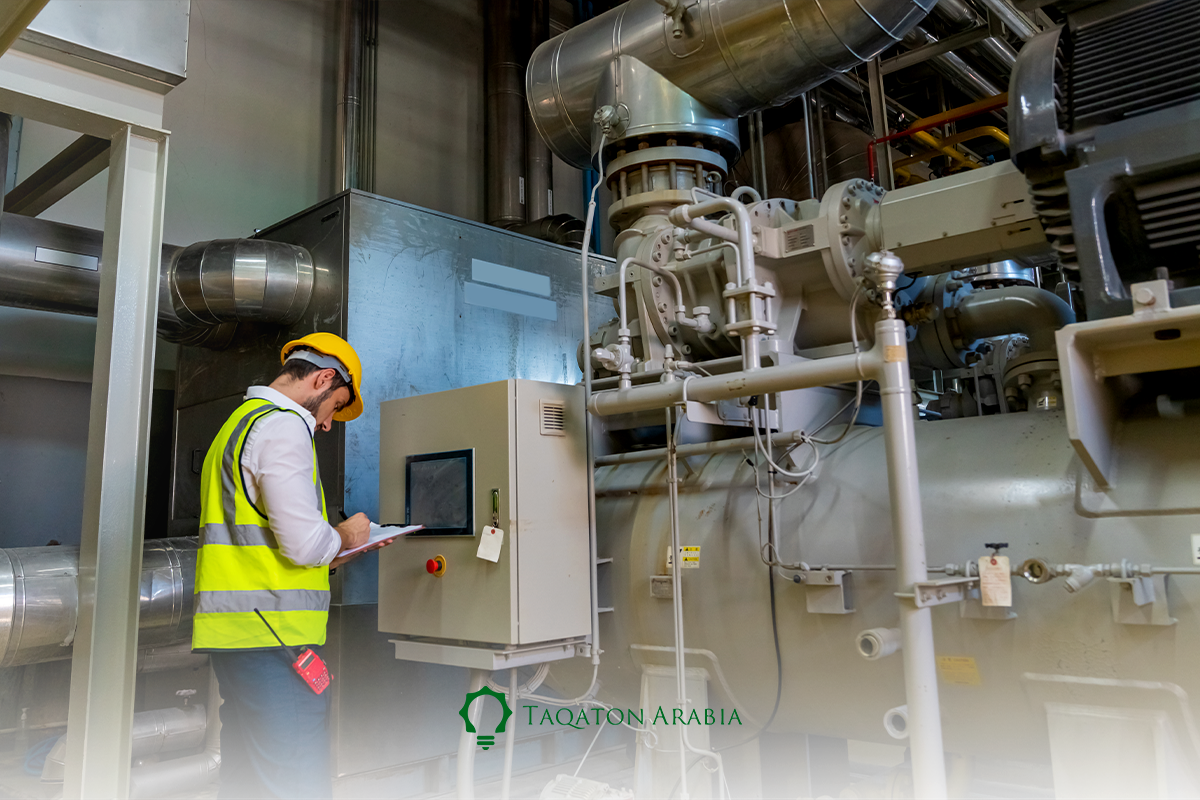
Equipment condition can be assessed continuously through sensors or periodically using inspection and diagnostic technologies such as vibration analysis, Thermal Imaging / Thermography, ultrasound, and oil analysis.
The basic principle is straightforward: monitor selected indicators, determine whether equipment is operating within its normal condition, and investigate when the data shows meaningful deterioration or abnormal behavior.
ISO 17359 provides general guidelines for establishing machine condition monitoring programs and applies to different types of machinery.
Key Characteristics of Condition-Based Maintenance:
A condition-based strategy has several characteristics that distinguish it from conventional maintenance approaches:
- Maintenance decisions are based on equipment condition.
- Relevant operating parameters are measured and monitored.
- Current readings are compared with normal or historical conditions.
- Abnormal trends can trigger further investigation.
- Maintenance resources can be prioritized according to equipment condition.
- Historical data can be retained to identify gradual deterioration.
- Different diagnostic technologies can be combined when necessary.
The purpose is not simply to collect more data. The data must support a clear maintenance decision.
Order the service now from Taqat Arabia website
How Does Condition-Based Maintenance Work?
The process normally includes several connected stages.
Sensors and Inspection Technologies
Different assets require different indicators.
Common parameters include:
- Temperature.
- Vibration.
- Pressure.
- Electrical current and voltage.
- Speed.
- Lubricant condition.
- Acoustic or ultrasonic signals.
Facilities may use permanent sensors for continuous monitoring or portable diagnostic instruments for periodic inspections.
Data Collection
Measurements are collected under relevant operating conditions and recorded for analysis.
Some facilities use continuous monitoring systems, while others perform scheduled inspections based on asset criticality and operating requirements.
Data Analysis
Current data is compared with established baselines, historical readings, operating limits, or similar components.
The objective is to identify trends or deviations that may indicate developing deterioration.
Alerting and Maintenance Decisions
When monitored values exceed an established limit or an abnormal trend appears, the maintenance team can investigate the condition further.
The alert itself is not always a diagnosis. Additional measurements and engineering analysis may be required before deciding on corrective action.
The U.S. Department of Energy notes that equipment data and monitoring systems can support condition-based recommendations by detecting performance degradation before failure.

Order the service now from Taqat Arabia website
Condition-Based Maintenance vs. Predictive Maintenance:
Condition-Based Maintenance (CBM) and Predictive Maintenance (PdM) are closely related, but they are not exactly the same.
Condition-based strategies primarily focus on the current condition of the asset. When monitored parameters show meaningful deterioration, maintenance can be scheduled.
Predictive maintenance goes further by analyzing current and historical information to estimate how equipment condition may develop and when maintenance could become necessary.
A simple distinction is:
- Condition-Based Maintenance: What is the condition of the equipment now?
- Predictive Maintenance: How is the condition developing, and when may intervention be required?
In practice, condition monitoring often provides the data required for more advanced predictive maintenance programs.
The Department of Energy distinguishes predictive maintenance from time-based preventive maintenance by linking maintenance need to measured equipment condition rather than only to a preset schedule.
Difference Between Condition-Based, Preventive, and Corrective Maintenance:
The main difference between these maintenance approaches is what triggers action.
Preventive Maintenance
Preventive Maintenance is commonly performed according to predetermined intervals, such as calendar time, operating hours, or manufacturer recommendations.
An asset may therefore receive maintenance even when no measurable deterioration has appeared.
Condition-Based Maintenance
Maintenance is triggered by evidence from the actual operating condition of the equipment.
The purpose is to perform the appropriate intervention when monitoring indicates a real need.
Corrective Maintenance
Corrective maintenance takes place after a defect or problem has been identified.
It may be planned when deterioration is detected early, or unplanned when the equipment fails unexpectedly.
The Department of Energy describes corrective or reactive maintenance as repairing equipment after failure and preventive maintenance as primarily time-based, while predictive approaches aim to identify degradation before failure.
Order the service now from Taqat Arabia website
Types of Condition-Based Maintenance:
No single monitoring technology is suitable for every asset. The correct method depends on the equipment and the failure mode that needs to be detected.
Vibration Analysis
Vibration analysis is widely used for rotating machinery such as motors, pumps, fans, and compressors.
Changes in vibration patterns may provide early indications of conditions such as imbalance, misalignment, or bearing-related problems.
Thermal Imaging
Thermal Imaging / Thermography measures and visualizes temperature patterns across equipment and systems.
For electrical applications, Electrical Thermal Inspection can help identify abnormal heating at electrical connections, circuit breakers, cables, and distribution equipment.
Thermal Imaging for Electrical Panels can be particularly useful because the inspection is non-contact and allows maintenance teams to locate thermal abnormalities that may require additional electrical testing.
Taqaton Arabia provides thermal imaging within its condition monitoring scope for electrical equipment, mechanical applications, and other facility systems.
When organizations search for the Best Electrical Thermal Inspection Company, the evaluation should consider engineering expertise, inspection methodology, reporting quality, safety procedures, and the ability to interpret thermal findings—not only the thermal camera being used.
Oil Analysis
Oil analysis can be used to evaluate lubricant condition and identify contamination, degradation, or wear-related indicators inside applicable equipment.
This can provide information about both the lubricant and the internal condition of the asset.
Ultrasound Inspection
Ultrasound can support applications such as:
- Compressed air and gas leak detection.
- Steam trap inspection.
- Electrical inspection.
- Bearing condition monitoring.
- Medical gas inspection.
Taqaton Arabia’s condition monitoring portfolio includes ultrasound surveys for applications such as leak detection, medical gases, electrical inspection, and steam traps.
Order the service now from Taqat Arabia website
Condition-Based Maintenance Lifecycle:
An effective condition monitoring program should operate as a continuous cycle rather than a one-time inspection.
A typical lifecycle includes:
- Identify critical assets: Determine which equipment should receive priority based on criticality and failure consequences.
- Identify relevant failure modes: Understand how each asset is likely to deteriorate.
- Select monitoring parameters: Choose indicators such as temperature, vibration, ultrasound, or lubricant condition.
- Establish a baseline: Understand what normal operating behavior looks like.
- Collect data: Monitor continuously or perform periodic inspections.
- Analyze results: Compare current results with historical and reference data.
- Evaluate condition: Determine the significance of detected changes.
- Take action: Perform additional testing, adjustment, repair, or maintenance when required.
- Verify results: Recheck equipment after intervention.
- Update the maintenance record: Retain findings for future trend analysis.
ISO 17359 emphasizes the importance of a structured process when establishing a machine condition monitoring program.
Benefits of Condition-Based Maintenance:
The purpose of Condition-Based Maintenance is not to increase the amount of maintenance performed. Its value comes from performing the right maintenance when equipment condition indicates a genuine need.
Potential benefits include:
- Earlier detection of equipment deterioration.
- Reduced dependence on emergency maintenance.
- Better maintenance planning.
- More effective prioritization of maintenance resources.
- Reduced unnecessary scheduled maintenance.
- Improved equipment reliability.
- Improved equipment availability.
- Better use of maintenance data.
- Greater visibility into asset condition.
- Improved Operational Efficiency.
Condition monitoring and predictive practices can support more proactive decisions by detecting performance degradation before it progresses to failure.
However, condition monitoring should normally form part of a broader maintenance strategy rather than replacing every preventive or corrective maintenance task.
Order the service now from Taqat Arabia website
Industries That Benefit from Condition-Based Maintenance:
Condition monitoring can be particularly valuable in industries where equipment reliability is important and unexpected downtime can have significant operational consequences.
Manufacturing and Industrial Facilities
Industrial facilities operate assets such as motors, pumps, compressors, production machinery, electrical systems, and rotating equipment.
Monitoring these assets can help maintenance teams identify developing deterioration and prioritize intervention.
Hospitals and Healthcare Facilities
Healthcare facilities depend on electrical and mechanical infrastructure that supports continuous facility performance.
Condition monitoring can support reliability programs for critical electrical and mechanical systems.
Energy and Utilities
Power and utility facilities contain electrical and mechanical equipment where reliability, availability, and equipment condition are important operational considerations.
Commercial Facilities
Large buildings can apply condition monitoring to assets such as heating, ventilation, and air-conditioning equipment, pumps, electrical distribution systems, and other critical building systems.
Renewable Energy Facilities
Condition monitoring and analytics can also support maintenance strategies for solar plants and other renewable energy assets.
How to Successfully Implement Condition-Based Maintenance:
Successful implementation begins with understanding the assets and their risks—not simply purchasing sensors or diagnostic equipment.
A practical implementation process should include:
- Identify critical equipment.
- Evaluate likely failure modes.
- Select the appropriate monitoring technology for each failure mode.
- Establish normal operating baselines.
- Define meaningful alert limits.
- Create a structured data collection process.
- Train technicians and engineers to interpret the data.
- Define what action should follow each type of alert.
- Record inspection and maintenance results.
- Review and improve the program over time.
Organizations do not necessarily need to monitor every asset from the beginning.
A pilot program focused on critical equipment can provide useful experience before expanding the strategy across a larger facility.
Order the service now from Taqat Arabia website
Best Practices for Condition-Based Maintenance:
The effectiveness of a condition monitoring program depends on how the information is used.
Important practices include:
- Prioritize critical assets.
- Monitor indicators linked to realistic failure modes.
- Establish accurate baselines.
- Collect data under comparable operating conditions.
- Maintain historical inspection records.
- Use multiple diagnostic techniques when appropriate.
- Avoid making major maintenance decisions from a single measurement.
- Define clear alert and escalation procedures.
- Review alarm thresholds periodically.
- Maintain and calibrate monitoring equipment.
- Train personnel in both measurement and interpretation.
- Connect monitoring results with maintenance planning.
The Department of Energy also emphasizes that proper implementation and operator training are critical when using increasingly sophisticated predictive maintenance technologies.
Challenges of Condition-Based Maintenance and How to Overcome Them:
A condition monitoring program can provide limited value if it is implemented without clear objectives.
Monitoring the Wrong Assets
Not every piece of equipment requires continuous or advanced monitoring.
Solution: Use asset criticality and failure consequences to determine where monitoring provides the most value.
Too Much Data
Facilities can collect large volumes of data without knowing which indicators actually matter.
Solution: Define relevant parameters, limits, and required actions before expanding data collection.
Poor Alert Thresholds
Incorrect limits may generate excessive alerts or fail to identify meaningful deterioration.
Solution: Develop thresholds using baseline data, operating conditions, historical results, and engineering judgment.
Lack of Technical Expertise
A sensor, thermal camera, or ultrasound instrument does not diagnose every problem automatically.
Solution: Ensure measurements are interpreted by personnel who understand both the monitoring technology and the equipment being assessed.
Initial Implementation Costs
Monitoring technologies, software, training, and instrumentation can require initial investment.
Solution: Start with a focused program for critical assets, measure its effectiveness, and expand where justified.
Order the service now from Taqat Arabia website
Other Services Offered by TAQATON Arabia Company:
In addition to Equipment Condition Monitoring, Taqaton Arabia provides engineering solutions across Power Systems, Energy Efficiency, and Renewable Energy. Its service portfolio also includes Thermal Imaging and Ultrasound Survey within condition monitoring.
Thermal Imaging and Electrical Inspection
Taqaton Arabia uses thermal imaging to detect and document abnormalities across electrical equipment and other facility systems.
Ultrasound Survey
Ultrasound applications include leak detection, medical gas testing, electrical inspection, and steam trap assessment.
Power Systems
Taqaton Arabia’s Power Systems services include:
- Power Logging.
- Electrical Safety Audit.
- Harmonics Study.
- Earth Resistance Test.
- Arc Flash Hazard Analysis.
These services are intended to support power quality, system performance, reliability, and electrical safety.
Energy Efficiency
The company’s Energy Efficiency scope includes energy audits, lighting assessments, heating, ventilation and air-conditioning assessments, and solar plant audits.
Renewable Energy
Taqaton Arabia also provides renewable energy solutions including solar photovoltaic systems, solar street lighting, automatic photovoltaic cleaning, and solar plant operation and maintenance with advanced analytics.
Contact TAQATON Arabia Company:
If your facility needs a structured approach to equipment condition monitoring, thermal imaging, ultrasound inspection, or predictive maintenance support, Taqaton Arabia can help evaluate your requirements and determine an appropriate inspection and monitoring scope.
Taqaton Arabia — +966561162097
Contact Taqaton Arabia to request a consultation and discuss condition monitoring and maintenance solutions for your facility.
Order the service now from Taqat Arabia website
Our Clients:
Taqat Arabia is proud to be trusted by a select group of leading organizations across diverse sectors, including:
NEOM, Jeddah Airports Company (JEDCO), Heritage Sites Co., and Saudi Sdn Water & Energy Co. In the healthcare sector, it works with the Armed Forces Medical Services, Andalusia Hospitals, International Medical Center, and Jamjoom Pharma. In hospitality, its clients include leading global brands such as Marriott, Ramada, Park Inn by Radisson, Four Points by Sheraton, Mövenpick Hotel & Residences Riyadh, and Aloft Hotels. Its clients also include major groups and companies such as Landmark Group, Zahid Group, Bin Dawood, Halwani Bros, Tamgo, ARASCO, Baytoti, Al Adwani, Mohammad Al Habib, Arabian Japanese Membrane Company (AJMC), GCC Electrical Testing Laboratory, and SMI.





Order the service now from Taqat Arabia website
Frequently Asked Questions:
What are the most popular Condition-Based Maintenance techniques?
Common techniques include vibration analysis, thermal imaging, oil analysis, and ultrasound inspection. The appropriate technique depends on the asset and the failure mode being monitored.
Is Condition-Based Maintenance suitable for all equipment?
No. It is generally most valuable for important assets whose condition can be monitored and where early detection of deterioration provides clear operational value.
Which industries use Condition-Based Maintenance?
It is widely applicable to manufacturing, industrial facilities, healthcare, energy and utilities, commercial facilities, and other operations that depend on critical electrical or mechanical equipment.