
In industrial environments and electrical power systems, operational safety is an essential element to ensure work continuity and the protection of individuals and equipment.
Among the electrical hazards that may threaten operational efficiency and facility safety, Arc Flash stands out as one of the most dangerous phenomena that can lead to severe equipment damage or serious injuries to workers.
Hence, the importance of an Arc Flash study emerges as a fundamental step to:
- Evaluate potential electrical risks.
- Analyze their impact on operational systems.
- Take appropriate preventive measures to mitigate their hazards.
At Taqat Arabia, we believe that conducting an Arc Flash study is not merely about complying with safety requirements; it represents a strategic investment to protect human and material assets within industrial and commercial facilities.
What is an Arc Flash?
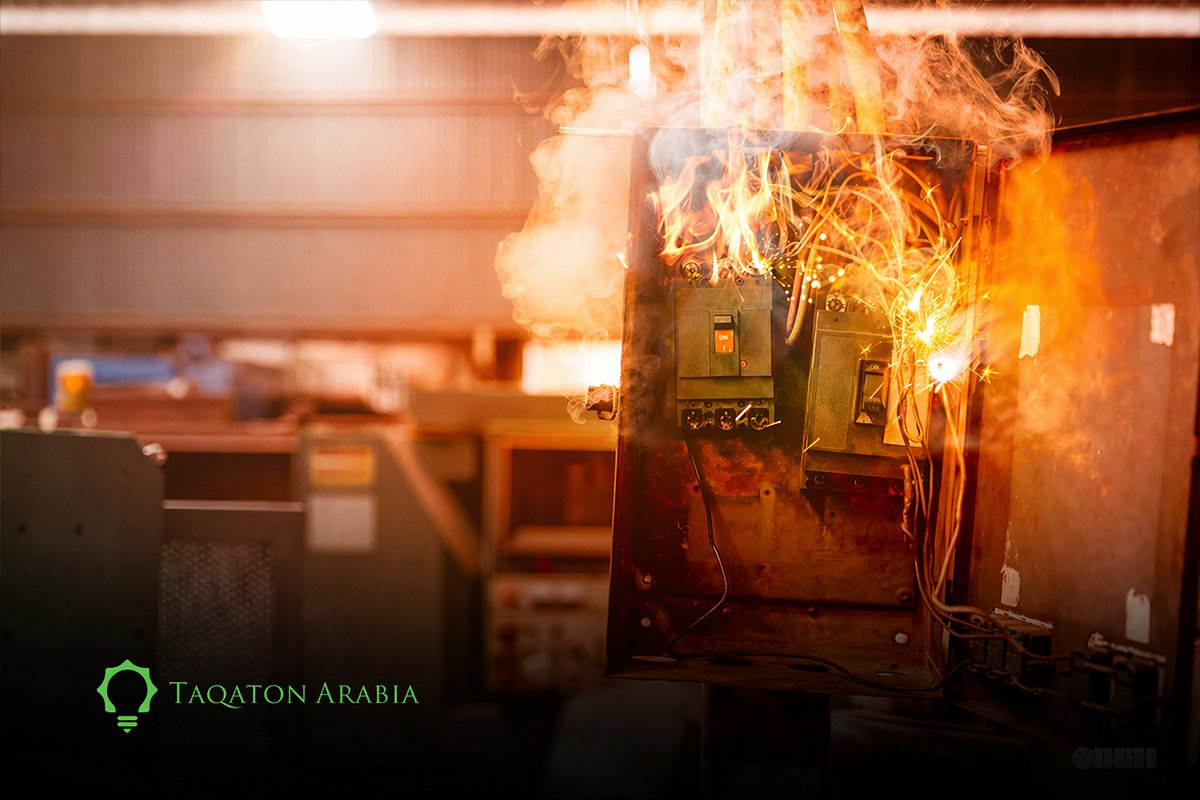
Arc Flash is a dangerous electrical phenomenon that occurs due to a sudden discharge of electrical energy between two or more conductors. This happens as a result of a fault or defect in the insulation system, or due to unintentional contact between current-carrying parts.
This discharge generates massive thermal energy in a very short period, with temperatures that may reach thousands of degrees Celsius, leading to:
- Melting of metals inside electrical equipment.
- Generation of powerful pressure waves that may cause device damage.
- Emission of intense light and high heat that can cause serious burns to workers.
- Outbreak of fires or explosions in electrical systems.
The Arc Flash phenomenon often occurs inside electrical distribution boards, during maintenance work, or as a result of equipment failure. This makes an Arc Flash study essential to determine the risk level and take appropriate preventive measures.
By conducting an Arc Flash study, it is possible to:
- Analyze the probability of this phenomenon occurring.
- Determine safe distances for workers.
- Select appropriate Personal Protective Equipment (PPE).
- Reduce the risks of electrical accidents within facilities.
Also Read: The Importance Of Preventative Maintenance For Electric Motors
Order the service now from Taqat Arabia website
What Is an Arc Flash Study?
An Arc Flash Study is a detailed engineering analysis conducted to evaluate the risk of arc flash hazards within an electrical power system. An arc flash is a dangerous electrical explosion caused by a short circuit or equipment failure, which can generate extremely high temperatures, intense pressure waves, and molten metal fragments within milliseconds.
The purpose of an arc flash study is to determine the potential incident energy levels at various points in an electrical system and to define the appropriate safety boundaries and required personal protective equipment (PPE). The study involves analyzing system components such as switchgear, transformers, circuit breakers, and distribution panels.
Arc flash calculations are typically performed in accordance with IEEE 1584, the internationally recognized standard for incident energy analysis and arc flash hazard assessment.
By performing an arc flash study, organizations can identify hazardous areas, implement proper labeling, and establish safety procedures that reduce the risk of injuries, equipment damage, and operational downtime.
Why Is an Arc Flash Study Important?
An arc flash study is critical for protecting personnel, ensuring regulatory compliance, and maintaining operational reliability. Electrical arc flash incidents can result in severe injuries, fatalities, significant equipment damage, and costly downtime.
Key reasons why an arc flash study is important include:
- Employee Safety: It helps determine safe working distances and appropriate PPE requirements for maintenance staff and electricians.
Regulatory Compliance: Many safety standards require arc flash risk assessments and proper equipment labeling. This study helps ensure compliance with NFPA 70E, which defines electrical safety requirements and safe work practices.
-
Risk Reduction: Identifies system weaknesses and recommends corrective actions such as coordination adjustments or equipment upgrades.
- Operational Continuity: Minimizes unexpected failures and downtime caused by electrical faults.
- Financial Protection: Reduces liability risks and potential legal costs associated with workplace accidents.
Conducting a professional arc flash study ensures that electrical systems are not only efficient but also safe and compliant with industry standards.
Arc Flash Study Requirements:
Conducting an effective arc flash study requires accurate data, proper system modeling, and compliance with recognized safety standards. The main requirements typically include:
- Up-to-Date Electrical Single-Line Diagrams: Accurate documentation of the electrical distribution system.
- Equipment Data Collection: Detailed information about transformers, cables, breakers, protective devices, and panel boards.
-
Short-Circuit Analysis: Calculation of available fault current at different system points. These calculations are performed in accordance with IEC 60909, the international standard for short circuit current calculation. Short circuit analysis is a critical input for arc flash calculations, as fault current levels directly impact incident energy results.
-
Protective Device Coordination Study: Ensuring protective devices operate correctly to minimize incident energy.
-
Incident Energy Calculations: Determining the arc flash boundary and required PPE levels. The selection of Personal Protective Equipment (PPE) follows IEC 61482 standards, which define protective performance requirements against arc thermal hazards.
-
Proper Equipment Labeling: Installing warning labels that indicate hazard levels and safety requirements.
Regular updates of the arc flash study are necessary whenever system modifications, expansions, or equipment replacements occur.
Also Read: How Can You Detect Compressed Air Leaks with Taqat Arabiya?
Order the service now from Taqat Arabia website
What to Expect from Taqat Arabiya’s Arc Flash Study Process
At Taqat Arabiya, our Arc Flash Study process is designed to ensure maximum electrical safety, regulatory compliance, and operational reliability. We follow a structured, engineering-based approach to deliver accurate results and practical recommendations tailored to each facility’s needs.
- Initial Consultation and Scope Definition
We begin by understanding the facility’s electrical infrastructure, operational requirements, and project objectives. The scope of work is clearly defined to ensure all critical system components are included in the study. - Detailed Data Collection
Our engineering team conducts a comprehensive site survey to collect accurate data, including single-line diagrams, equipment ratings, protective device settings, cable specifications, and transformer details. Accurate data collection is essential for reliable arc flash calculations. - System Modeling and Analysis
Using advanced engineering software, we perform:
- Short-circuit analysis
- Protective device coordination study
- Arc flash incident energy calculations
This step determines fault current levels, arc flash boundaries, and required personal protective equipment (PPE).
- Risk Assessment and Recommendations
We evaluate the findings to identify high-risk areas and provide practical mitigation solutions. Recommendations may include adjusting protection settings, upgrading equipment, or improving system coordination to reduce incident energy levels. - Labeling and Compliance Support
We provide arc flash warning labels for electrical panels and equipment in accordance with applicable safety standards. Our team ensures that your facility meets regulatory requirements and industry best practices. - Final Report and Ongoing Support
Clients receive a comprehensive report that includes all calculations, system analysis results, risk evaluations, and actionable recommendations. We also offer ongoing technical support to assist with implementation and future system updates.
Through this structured process, Taqat Arabiya ensures that your electrical systems are not only compliant but also safer, more reliable, and optimized for long-term performance.
Order the service now from Taqat Arabia website
What Information is Required to Conduct an Arc Flash Analysis?
Conducting an Arc Flash study and risk analysis requires a set of accurate technical data regarding the facility’s electrical system. This information is used to evaluate the probability of an arc flash occurring, determine the resulting energy level, and identify appropriate preventive measures to protect personnel and equipment.
The most prominent information required for the analysis includes:
1. Electrical Power System Data
- Single Line Diagrams (SLD).
- Operating voltage of the electrical grid.
- Transformer capacities and technical specifications.
- Generator data and electrical power sources.
2. Electrical Protection Device Data
- Circuit Breaker settings.
- Protection Relay characteristics.
- Trip curves for protection devices.
- Response time of protection systems during faults.
3. Cables and Components Information
- Cable lengths and cross-sections.
- Type of conductors used.
- Data on distribution boards and control centers.
4. Potential Short-Circuit Currents
- Maximum short-circuit current at various points in the system.
- Results of previous short-circuit studies, if available.
5. Operating Environment
- Locations of electrical equipment within the facility.
- Operating and loading conditions on the grid.
- Distances between workers and electrical equipment.
6. Maintenance and Operational Data
- Previous maintenance records for equipment.
- Fault history, if any.
- Condition of electrical insulation for components.
This data is utilized in the study to accurately determine hazard levels, establish safe working distances, and select appropriate Personal Protective Equipment for workers.
At Taqat Arabia, we ensure the collection and analysis of all this information with high precision to guarantee that the Arc Flash study is performed according to the best technical standards.
Also Read: Thermal Imaging: What is It and How it Works
Order the service now from Taqat Arabia website
The Seven Steps to Complete an Arc Flash Analysis
- Collection of technical data for the electrical system
- Conducting a short-circuit current study
- Analysis of protection system coordination
- Calculation of Incident Energy
- Determination of protection boundaries and safe distances
- Selection of appropriate Personal Protective Equipment
- Preparation of reports and placement of warning labels
Other services provided by Taqat Arabia for Smart Engineering Solutions
In addition to Arc Flash studies, Taqat Arabia offers an integrated suite of smart engineering services to enhance electrical system efficiency and operational safety. These services include:
- Smart maintenance and continuous monitoring for early fault detection using advanced techniques such as thermal monitoring and ultrasonic analysis.
- Energy auditing and usage strategy analysis to improve efficiency and reduce costs.
- Advanced electrical studies and maintenance for transformers, distribution boards, and critical equipment.
- Renewable energy solutions, such as solar power systems.
All these services aim to improve performance, enhance security, and achieve long-term operational sustainability.
Order the service now from Taqat Arabia website
FAQs:
-
Who Needs an Arc Flash Study?
Any industrial or commercial facility operating on medium or low voltage systems to ensure personnel safety and equipment protection.
-
Who performs an arc flash study?
Specialized engineering firms, such as Taqat Arabia, using advanced simulation software and technical expertise.
-
How often should an arc flash study be done?
Every 3 to 5 years, or whenever significant changes are made to the electrical system or protection settings.